
The Paris Agreement, 10 years on
Translated by Laura SteeghsOn the 12th of December 2015, 195 countries signed the Paris Climate Agreement – a shared framework for global climate action. Its central aim: to limit global warming to well below 2°C, and ideally to 1.5°C, compared to pre-industrial levels. Ten years later, progress has been made. Yet there is still a significant gap between the ambitious goals and their implementation.
The origins of the Paris Agreement
For over 30 years, the member states of the UN Framework Convention on Climate Change (UNFCCC) have been negotiating global climate policy at annual climate conferences (COPs). The Paris Agreement marked a turning point: it was the first agreement to involve almost all countries worldwide, industrialised and developing countries alike. Each country sets its own climate targets through the Nationally Determined Contributions (NDCs), outlining how they aim to reduce emissions. However, as recent political debates have repeatedly shown, and as the Federal Environment Agency currently reports (in German), implementation remains a challenge.
6 essential facts about the Paris Climate Agreement
1. A global approach: almost all countries are involved
The agreement commits both industrialised and developing countries to reduce their greenhouse gas emissions under a clear mandate: climate protection affects everyone and is therefore a shared responsibility. At the same time, the NDC system accounts for different capacities and responsibilities. Industrialised countries, for instance, are expected to support developing countries with know-how and financial resources. While there are no direct sanctions for missing targets, the “global stocktake” – a regular review of collective progress – ensures** transparency**.
2. Fossil fuels must be reduced further as a matter of urgency
The decision to move away from coal, oil and gas has been made, but implementation is slow. **By 2030, renewable energy capacity is meant to triple and energy efficiency to double. **Without decisive action, dependence on fossil fuels will persist.
Across the EU, emissions from industry, transport and buildings are being reduced, fossil fuels are being gradually replaced, and CO2 pricing through emissions trading (which we explain in this blog article is creating incentives for the use of clean technologies. This is where ForTomorrow comes in. How? You will find out at the end of this article. Electric cars, alternative drive systems and international regulations such as the Carbon Border Adjustment Mechanism (short: BAM - we also have a blog article on this) are contributing to the achievement of these goals.
Key mechanisms at a glance
EU Emissions Trading System (EU ETS)
Has regulated industrial CO2 emissions since 2005. All major CO2 emitters require emission rights for their emissions. One tonne of CO2 corresponds to one emission right. Those who emit less can sell surplus rights; those who emit more must purchase ones. This market-based system creates economic incentives for the implementation of clean technologies while capping total emissions. Read more about the EU ETS system in one of our blog articles linked above, What is EU emissions trading?
ETS 2
Planned to include buildings and road transport, ETS 2 is now scheduled to start in 2028. Price signals are intended to promote investment in climate-friendly technologies.
End of combustion engines & electromobility
From 2035, no new cars with CO2 emissions will be allowed registration in the EU. Expanding electric mobility is key in helping to achieve the Paris Agreement targets in the transport sector, although the regulation is still under discussion.
Carbon Border Adjustment Mechanism (CBAM)
Introduces a CO2 price on imported emission-intensive raw materials such as steel, iron and aluminium. Its goal is to reduce global carbon emissions, ensure fair competition and prevent companies from outsourcing their production to countries with weak climate regulations. Imports of less than 50 tonnes of CBAM-relevant raw and basic materials per year are exempt. You can read the details in the blog article linked above, CBAM: What is the Carbon Border Adjustment Mechanism?
3. Global warming is not yet under control
Despite improved NDCs, current trajectories point to 2.3–2.5°C of global warming by 2100. The UNEP Emissions Gap Report 2025 shows that the agreed targets are not sufficient to stay below the 1.5°C limit set out in the Paris Agreement.
Germany’s climate check
Germany has already implemented a number of measures – expanding renewable energies, promoting energy efficiency, phasing out coal – in order to meet its obligations under the Paris Agreement. However, analyses by the Federal Environment Agency (UBA) show that additional efforts are needed. The current projections of the UBA (in German) confirm that the 2030 climate targets would otherwise be missed.
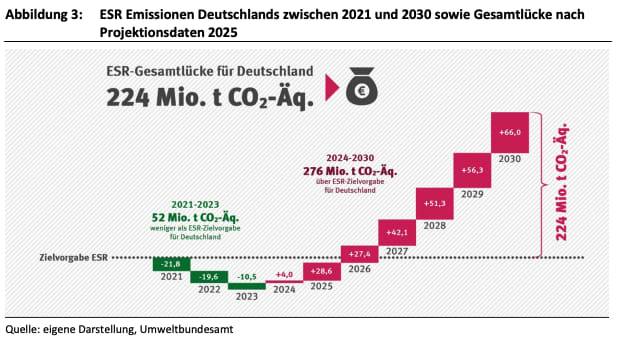
The Effort Sharing Regulation (ESR) specifies how Germany must reduce its greenhouse gas emissions in sectors outside the EU emissions trading system – e.g., transport, buildings and agriculture – between 2021 and 2030. The graph above shows a substantial gap between these ESR emissions and the targets.
4. Climate financing remains inadequate
The Paris Agreement relies on financial solidarity and stipulates that industrialised and emerging countries should support poorer countries so that climate protection can be implemented worldwide. As reported by the Federal Environment Agency, the original target of **100 billion US dollars per year **was only reached for the first time in 2022. A new goal of USD 300 billion annually from 2035 has been agreed, but key details on how the financing will be realised are still unclear, which, according to the European Council, makes it difficult to implement the targets.
5. Cooperation and knowledge sharing promote progress
The agreement promotes capacity-building and measurement of emissions as well as education and training programmes. These elements are essential for the implementation of NDCs. International cooperation is growing through climate clubs and alliances focused on topics such as methane reduction or clean energy; platforms such as the Climate Club show how countries are working together. At the same time, **social issues such as gender equality **and the empowerment of indigenous peoples, are increasingly highlighted in UN reports as important elements of a just climate policy. As marginalised groups in particular often bear the brunt of global warming, their perspectives are crucial for fair, effective and sustainable climate solutions.
One of the greatest achievements of the Paris Agreement is quite simply that over 190 countries now submit their own NDCs. Many have significantly improved their monitoring, reporting and verification (MRV) of greenhouse gas emissions, in particular through the new, mandatory transparency framework under the supervision of the UNFCCC, which requires standardised reporting and quality improvements.
What has already been achieved¹:
Expansion of renewable energies
- The share of renewables in global electricity generation has risen from ~23% (2015) to ~32% (2024). 2. Wind and solar capacity has more than doubled worldwide.
Electromobility & transport
- Global stock of electric vehicles increased from ~1.2 million to >40 million (2023). 2. The switch from combustion engines to electric cars is already reducing global CO2 emissions by millions of tonnes annually.
6. Why the 1.5°C limit matters
The 1.5°C threshold is critical. Exceeding it sharply increases the risk of extreme weather events, sea level rise and ecosystem collapse. At 2°C or more, heatwaves, floods, crop losses and conflict risks rise dramatically. The 1.5°C target is at** the heart of the Paris Agreement**, which sets this limit as a guideline.
You can find more background information, data and illustrative scenarios in our blog article What is the 1.5-degree target?, which explains why 1850 serves as the reference year and what overshooting the target would mean for our planet.
¹Sources: UN Energy Transition Report 2025, Global EV Outlook 2024/2025