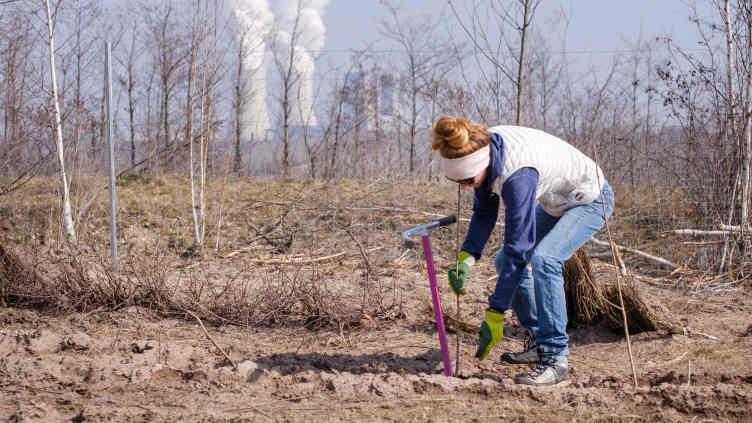
Our first site: a special beginning on challenging soil
The afforestation area in Peres near Leipzig is more than just a piece of land – it marks the beginning of our commitment to nature-based climate solutions. This is where we planted our very first trees. The 0.8-hectare site lies on a former open-cast mining area, dried out and ecologically depleted for decades. Now, new life is emerging here, finding its way back into the ecosystem.
The site was carefully prepared for its first afforestation – with milling work that opened up the soil for new life. A 400-meter-long wildlife fence ensures that the trees can grow undisturbed. In a joint effort, 4,000 young trees were planted – climate-resilient species well suited to the site’s special conditions.
Some of the trees were planted with the ForTomorrow team. In spring-like weather, Ruth and Koos rolled up their sleeves and got to work, laying an important foundation for ForTomorrow’s first reforested mixed forest. To ensure that the saplings grow into a stable, healthy forest, SDW will closely monitor the area’s development over the next few years.
Our objectives for this site
- For climate, soil, and water protection, and as a recreational space for people in the region
- More forest in a structurally forest-poor region, on a former mining site that is being revitalized
- Nature conservation through the development of a diverse biotope and its connection with neighboring forest areas
- Reduction of invasive sea buckthorn, which had overgrown large parts of the site