
Educational afforestation with Oppach Primary School
This spring, we headed out with another school class: fourth-graders from Oppach Primary School. Since the pupils live in the village, they could walk to the planting site themselves. Particularly nice is that they will be able to stop by whenever they like and watch their forest grow.
Timing could not have been better: after heavy rain the day before, the sun broke through just as the planting campaign kicked off – much to the delight of the 22 schoolchildren. Together we made our way to the 1.9-hectare site, where a climate-resilient mixed forest of sessile oak, hornbeam, sycamore, mountain elm, larch, wild cherry and various shrubs is now taking shape. You can find more details in our site profile:
Site profile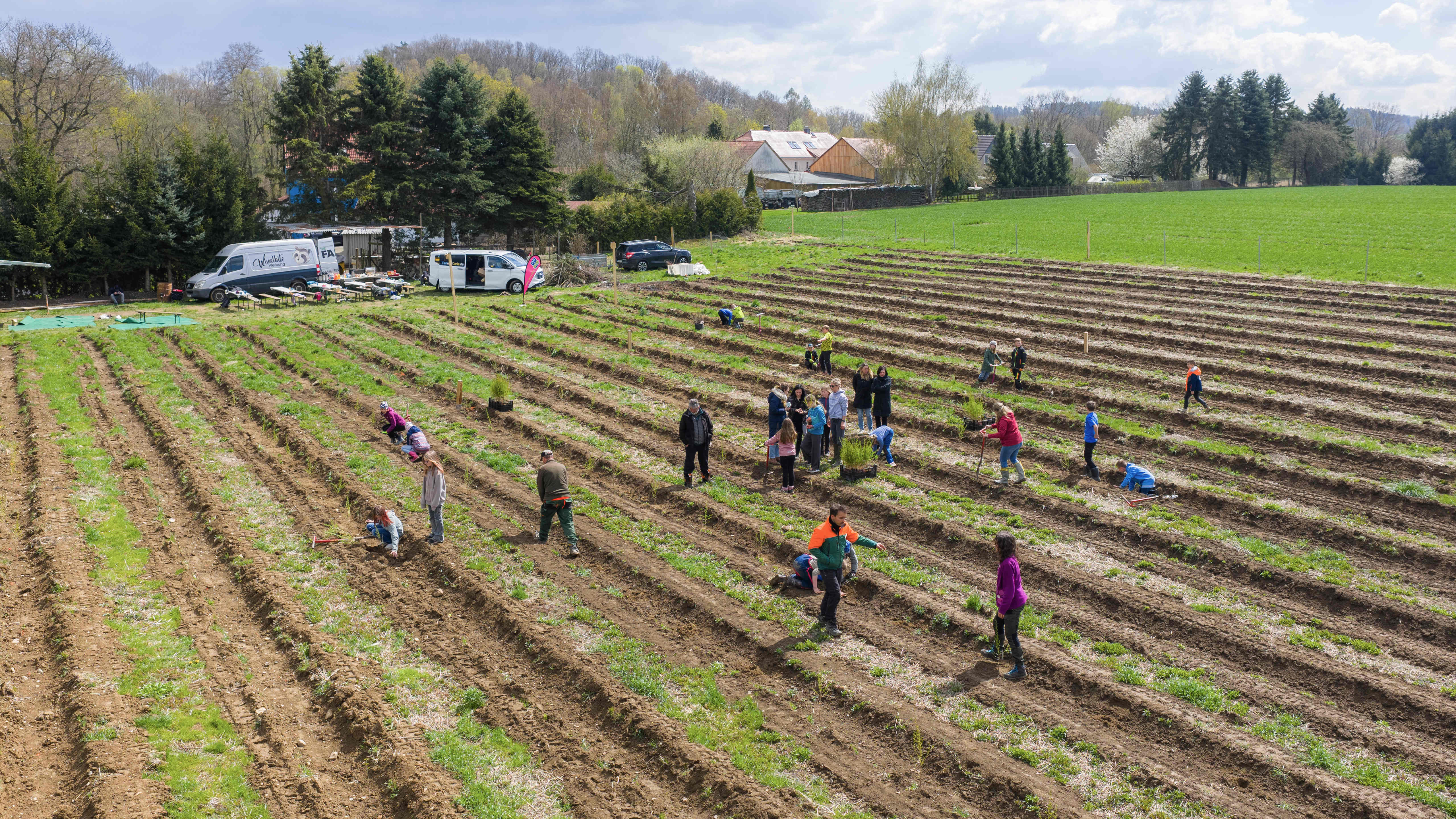

With the help of the students, a mixed forest is now being planted on this land that was formerly used for agriculture.
Learning by doing
The day in the forest was all about practical experience. No classrooms, just soil, plants and nature, explored together at a series of learning stations.
- The forest as a climate protector: how much CO2 does a tree actually store? The children discovered that an 80-year-old larch sequesters a whopping 33 kg of CO2 per year.
- Soil and the water cycle: moss, it turns out, works like a giant sponge. By absorbing water, it helps protect against flooding.
- Stability through diversity: in the mixed-forest game, the pupils explored why a forest made up of many different tree species is much better equipped to withstand storms and pests than a monoculture.
- The little helpers: we got to know inhabitants such as the springtail, which can jump using its tail and plays an important role in the soil.
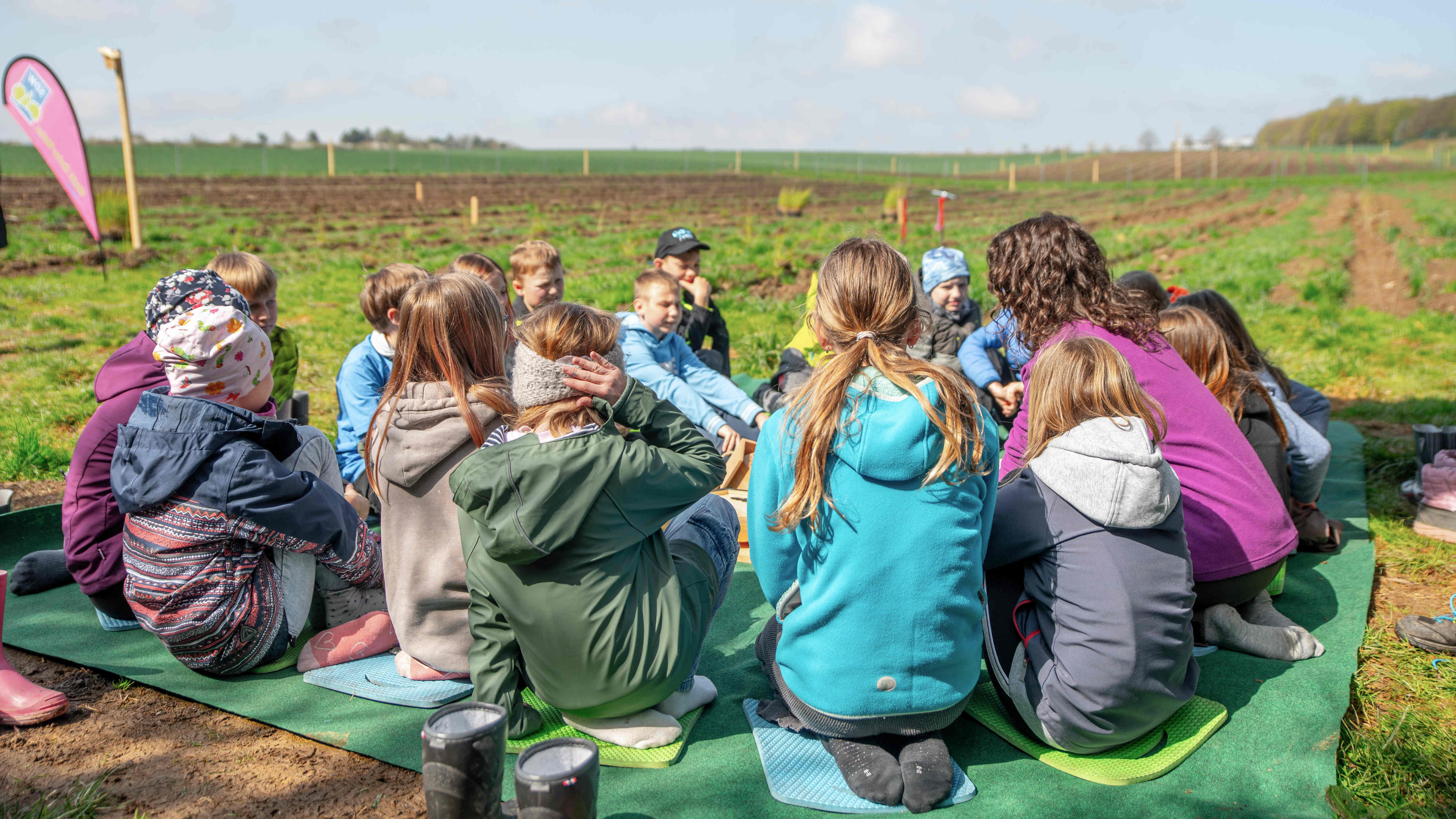
All pupils listen intently as the teacher Janine explains the role of biodiversity.
The forest as a living learning space
Once the importance of a new mixed forest was explained to the pupils, it was time for some hands-on work. As well as planting trees, the children also set up insect hotels and sowed bee pastures, thereby learning about the role of pollinators in the ecosystem. In addition, bat boxes, birdhouses and perches for birds of prey were put up to attract those animals that act as natural pest controllers, for example against mice or bark beetles.

Before the pupils set about planting the trees, forester Friedrich from the Schutzgemeinschaft Deutscher Wald Sachsen (SDW) gave a brief introduction.
The bat box provided a memorable moment: mid-installation, it fell off the pole, prompting forester Friedrich from the SDW and Carla from ForTomorrow to improvise a human ladder and get it safely back in place.
As the planting session drew to a close, some of the children had a hard time leaving the site. To continue their learning at home, each pupil received our self-written information booklet, Our Forest – A Climate Hero (in German), in which they can discover more interesting facts and collect pressed tree leaves.
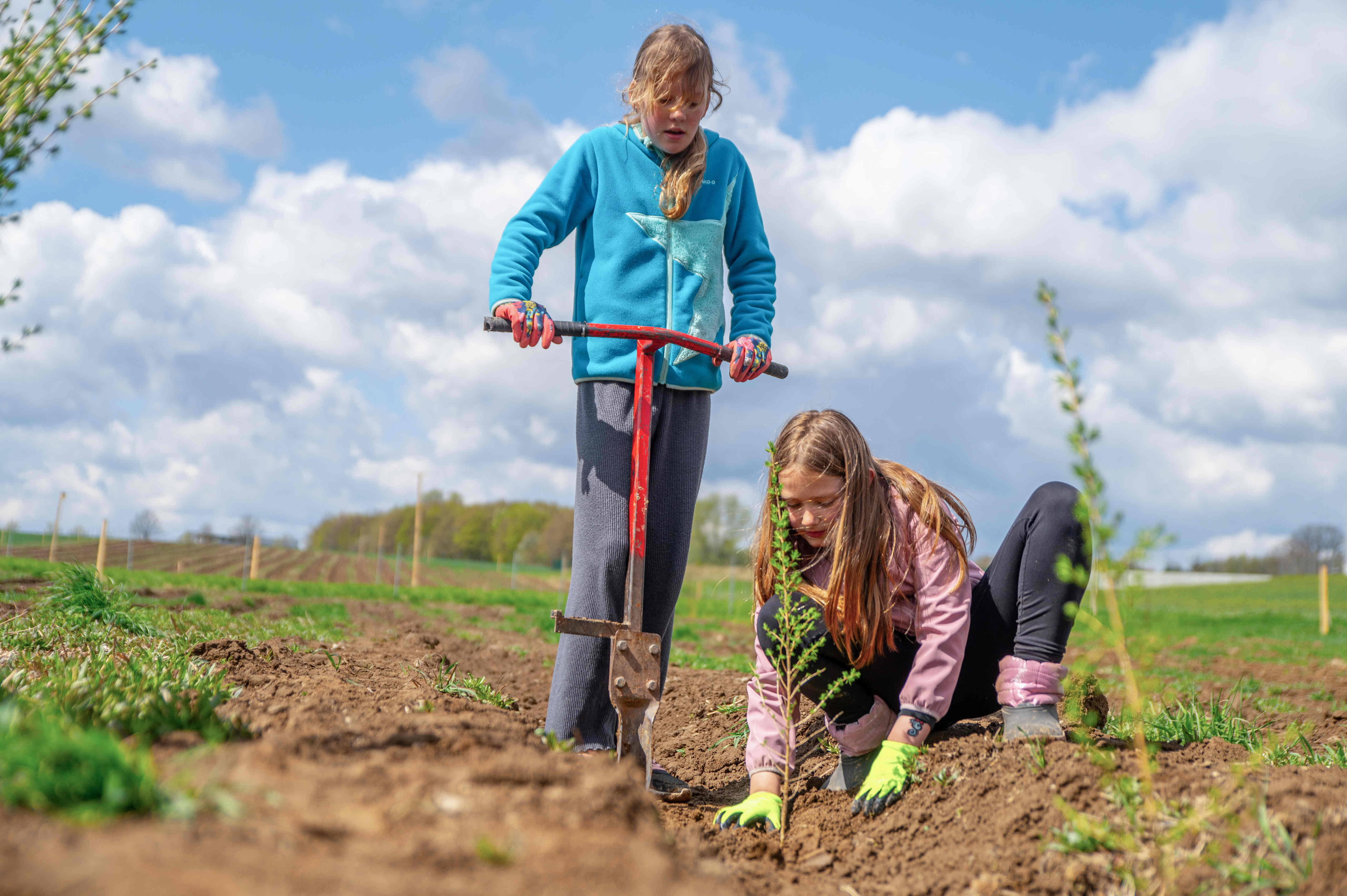
Using all their strength, these two pupils are planting one tree after another.
Made possible by the Postcode Lottery
This educational afforestation project with Oppach Primary School was funded by the German Postcode Lottery. The lottery supports projects nationwide in the field of nature, environment and climate protection, thereby enabling tangible local impact.
Thanks to their support, we were able to organise a day that demonstrates how climate protection and education can go hand in hand.
We would like to thank everyone who helped make this day such a wonderful experience for all involved!

At the end, all the pupils were given a planting certificate …

… and a bee house to encourage biodiversity at home.