
Translated by Laura Steeghs
Educational afforestation with Beiersdorf Primary School
In mid-April, we spent a day in the woods near Oppach in Saxony with a fourth-grade class from Beiersdorf Primary School. It was a day that will surely be remembered by many of the pupils: out of the classroom, into the woods—and right into the heart of practical climate action. The weather played along, and we were able to plant trees in the sunshine while learning more about the various functions of the forest.
On a prepared site that was previously used for agriculture, a climate-resilient mixed forest consisting of sessile oak, hornbeam, sycamore, mountain elm, larch, wild cherry and other shrubs is now taking shape across an area of 1.9 hectares.
The pupils planted young trees, thereby playing an active part in helping a new, healthy forest to grow.
Go to the site profile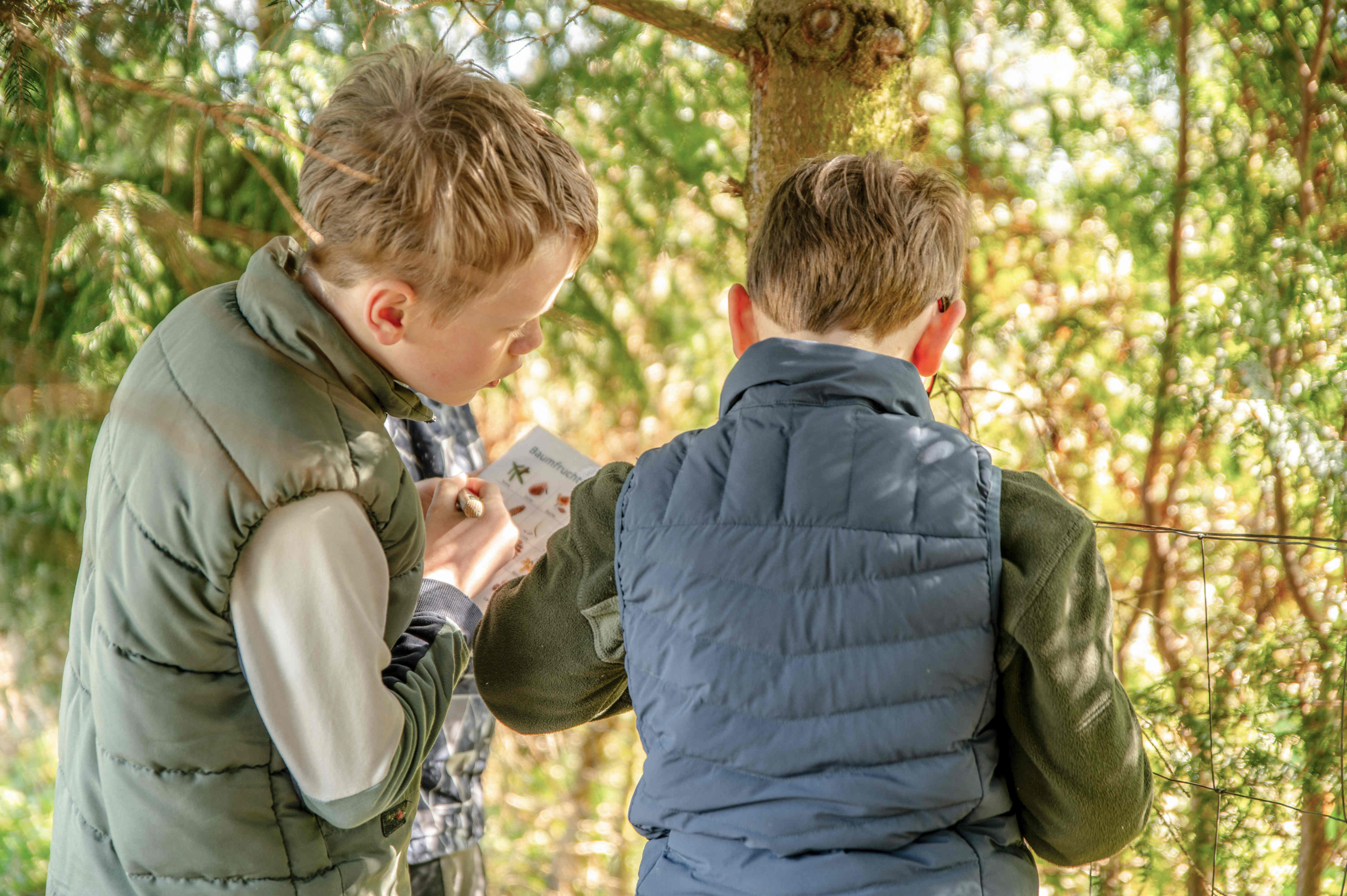
On this educational tree-planting day, the children become real forest experts.
Hands-on climate protection#
Before the pupils picked up their spades and saplings, they had to complete a few interactive learning stations. Instead of abstract theory, the focus was on direct experience: What does forest soil feel like? Why are trees planted in the first place? And what does that have to do with the climate?
Together, we discovered a lot at the interactive learning stations.
- Why mixed forests are more resilient: in a hands-on experiment, the pupils saw how a forest of pure spruce trees can be completely destroyed by a storm, whilst a diverse mixed forest is more stable and provides mutual support.
- How much CO2 trees can store: armed with measuring tapes, the pupils measured the circumference of old trees and calculated how much CO2 they store—ranging from the equivalence of the amount needed for a year’s worth of video gaming to a flight to South Asia.
- How the forest acts as a water reserve: we learnt that forest soil is a real powerhouse—a single cubic metre can store up to 300 litres of water, thereby protecting against flooding.
- Why biodiversity is essential for stable ecosystems: from the decomposing work of earthworms to springtails, we got to meet the soil’s tiny heroes.
Particularly striking was the moment when a simple planting initiative turned into something much bigger: the realisation that they themselves were part of a long-term ecological process.
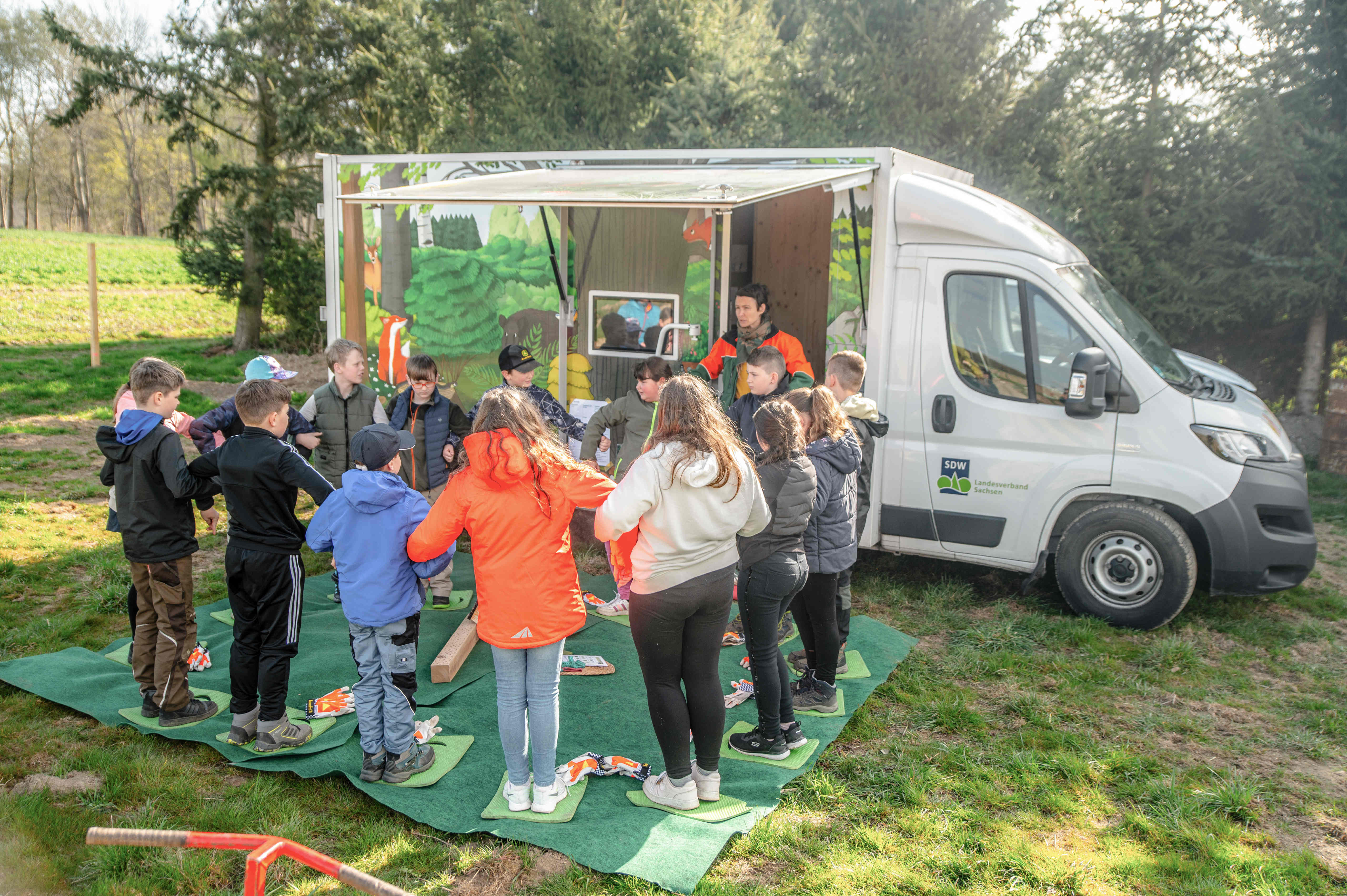
The forest van of SDW Sachsen serves as the perfect learning space, surrounded by nature. Here, the children play the mixed-forest game.
Ein Wald als Lernort#
The forest as a place of learning#
Once the learning stations were completed and the pupils understood why this new mixed forest is so important, we headed to the planting area. As well as planting trees, the children also set up insect hotels and sowed bee pastures, thereby learning about the role of pollinators in the ecosystem. In addition, bat boxes, birdhouses and perches for birds of prey were put up to attract those animals that act as natural pest controllers, for example against mice or bark beetles.
All the pupils took great delight in planting a few trees and announced their intention to visit the site regularly to see how quickly the trees grow. As the planting session drew to a close, some of them had a hard time leaving the site.
Not only did they get to experience the forest as a natural space, but also as a living, green classroom. This combination of hands-on activities and playful learning creates a connection to nature that has an impact far beyond the day of the field trip.
To continue their learning at home, each pupil received our self-written information booklet, Our Forest—A Climate Hero (in German), in which they can discover more interesting facts and collect pressed tree leaves.
Before the pupils set about planting the trees, the SDW foresters gave a brief introduction to each tree species and the correct planting procedure.

Before the pupils set about planting the trees, the SDW foresters gave a brief introduction to each tree species and the correct planting procedure.
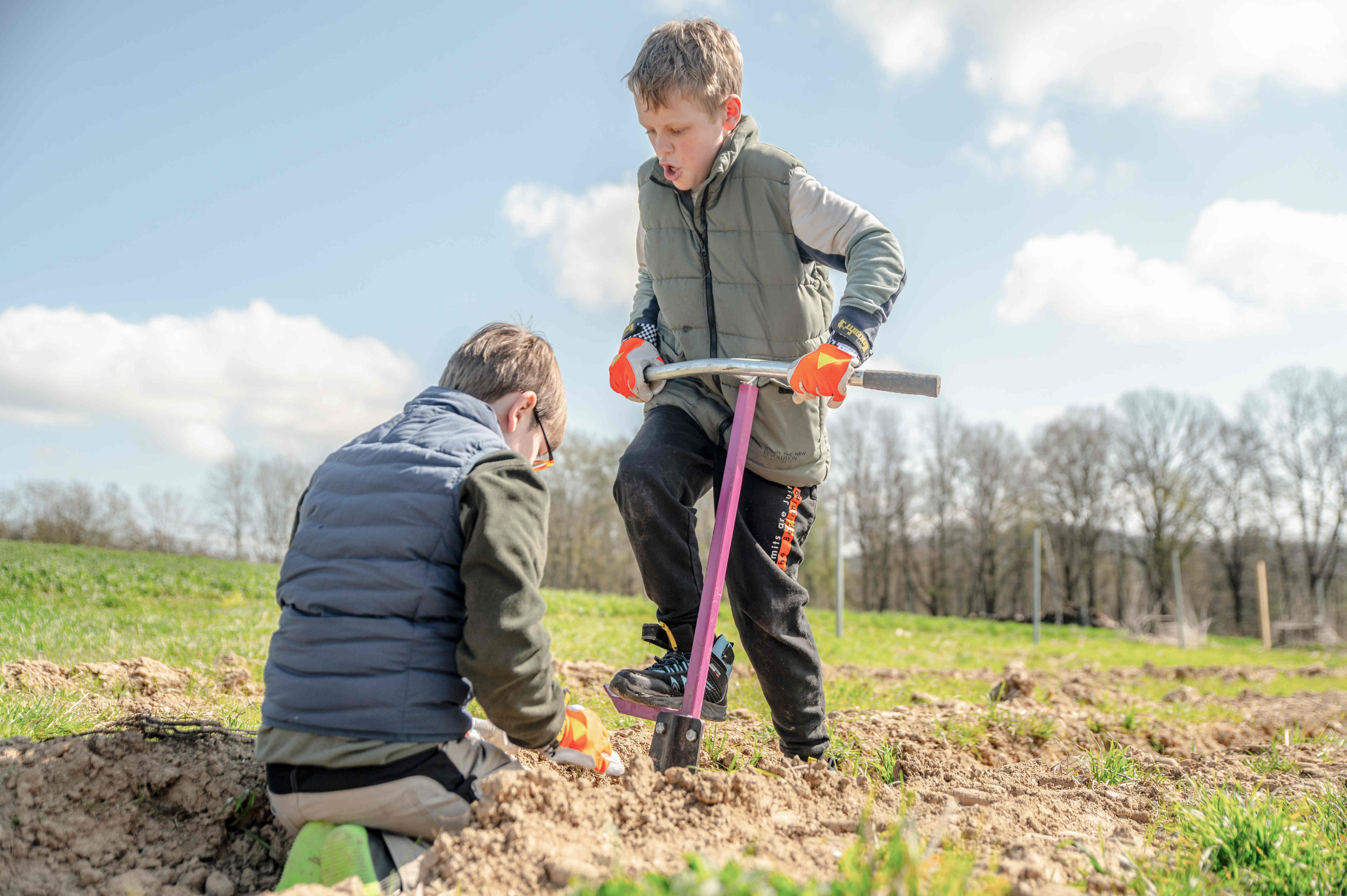
And then it’s time to grab a spade and a sapling. Step by step, a new mixed forest is taking shape.
Made possible by the Zurich Planet Hero Stiftung#
This educational afforestation project was funded entirely by the Zurich Planet Hero Stiftung. The foundation, part of the Zurich Group Germany, supports projects in climate protection, nature conservation and environmental education.
Thanks to their support, we were able to organise a day during which we not only shared knowledge but also provided a genuine nature experience.
At the end of the day, the children—and the adults too—celebrated a fantastic event and a new mixed forest.
Education gives us hope for the future#
Climate protection starts in our minds. It is about much more than simply presenting facts: we want to enable genuine participation and give people the confidence to take action themselves.
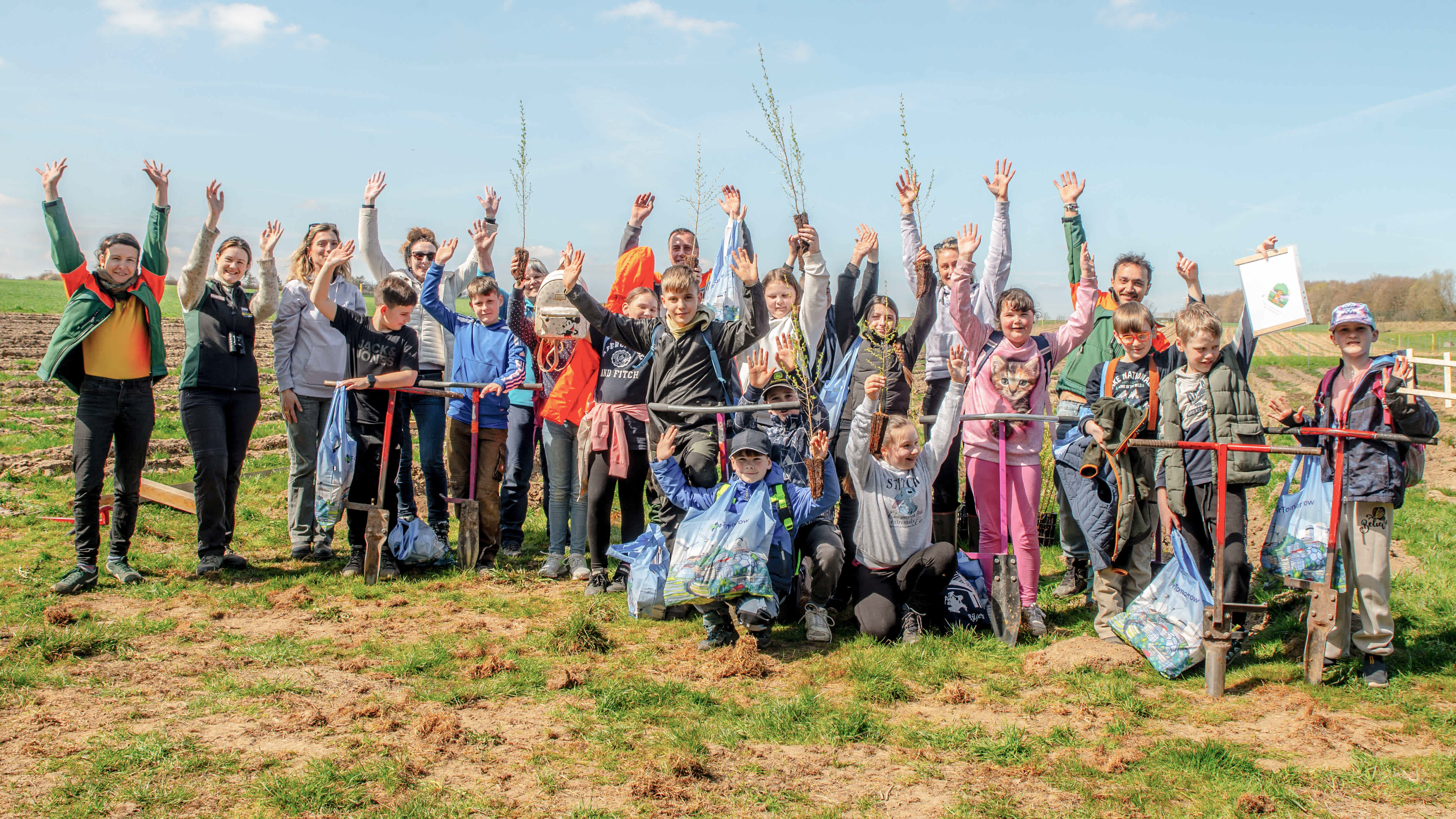
In the end, all the children—and the adults, too—were delighted with the wonderful event and the new mixed forest.